LANGUAGE
 中文简体
中文简体 русский
 Français
 Español
 Português
 عربى
عربى
Content
- 1 Five Control Loops That Decide Whether the Wall Holds
- 2 Manual, Basic PLC and Closed-Loop Control Compared
- 3 Hidden Metrics: Where the Losses Actually Sit
- 4 Where Control Effort Pays Off Most, by Cable Type
- 5 Commissioning Sequence: Six Steps That Lock the Settings In
- 6 Maintenance, Calibration and Compliance
A 70 mm PVC insulation line running at 300 m/min produces roughly 36 km of insulated core in a two-hour window. If the finished diameter drifts 0.05 mm outside the customer's tolerance for ten minutes of that window, several kilometres of core become scrap, the take-up spool has to be reworked, and the deviation is usually found at the customer's incoming inspection rather than on your own floor.
Extrusion process control is the set of feedback loops that prevents this outcome. It holds melt temperature, melt pressure, screw speed, line speed, diameter and tension inside defined windows, minute after minute, and it records what moved when something goes wrong.
The short answer: stabilise the melt first, then the dimension, then the tension. Temperature and pressure stability decide whether wall thickness holds; diameter and capacitance feedback decide whether the tolerance holds; tension and accumulation decide whether the line survives a changeover without stopping. Tune them in that order, because each loop disturbs the one downstream of it.
A line that logs melt pressure, hot diameter, wall thickness and take-up tension at one-second intervals will usually show where the losses sit within a week of running, long before any hardware upgrade is justified.
Five Control Loops That Decide Whether the Wall Holds
Process control on an extrusion line is not one controller. It is five loops that interact, and the interaction is what makes the job difficult.
Thermal profile
Five to seven barrel zones held within 3 degrees C, die zone within 2 degrees C.
Melt pressure
Transducer ahead of the screen pack, stability inside 1 percent of setpoint.
Screw and line speed
Screw rpm mapped to line speed, with draw-down of 1.4 to 1.6 for PVC insulation.
Dimensional feedback
Laser gauge 6 to 8 m from the die, capacitance gauge for wall thickness and eccentricity.
Tension and accumulation
Dancer position, take-up tension in newtons, and 30 to 90 seconds of stored length.
Melt temperature is the slowest loop and the one most often set by feel. On a typical insulation line, a 5 degrees C drift in the metering zone changes viscosity enough to shift finished diameter by 0.02 mm to 0.04 mm at constant screw speed. Thermocouples should be checked against a reference every quarter, because a sensor reading 4 degrees C low is usually compensated by an operator who raises the setpoint and never brings it back.
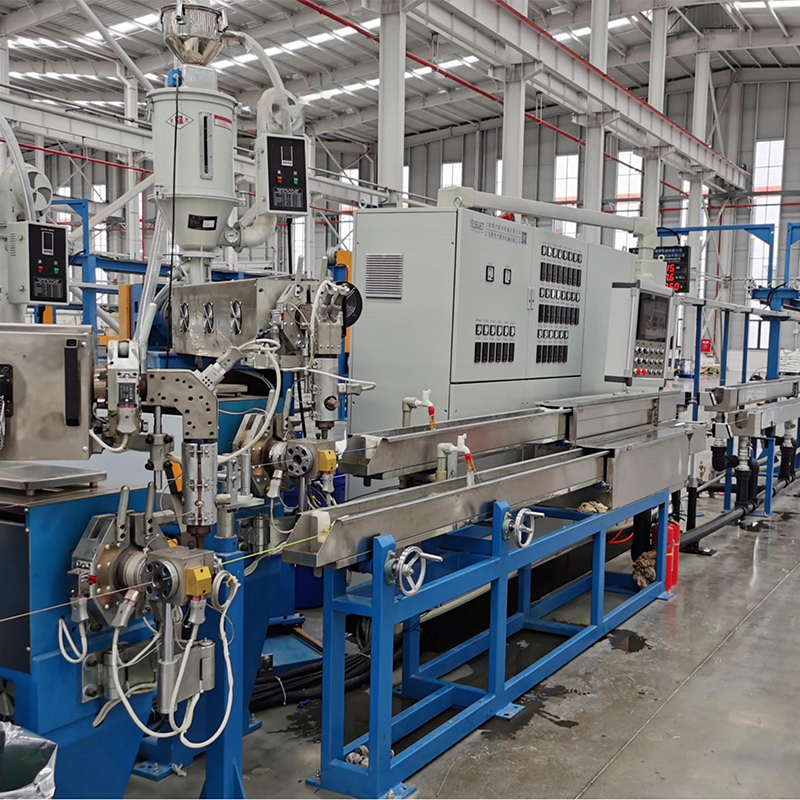
 Full Auto PE PVC High-Performance Cable ExtruderThe Full Auto PE PVC High-Perf Cable Extruder is an integrated production system designed to support cable manufacturers in efficient, high-precision production. It sp...View Product →
Screw geometry sets how much work the temperature loop has to do. A compression ratio matched to the compound produces a flat pressure profile; a mismatch shows up as surging head pressure that no amount of PID tuning will remove. Screen pack condition belongs in the control plan for the same reason: a partly blocked pack raises head pressure and changes output by 2 to 5 percent. The relationship between screw design, output and control stability is covered in this high-efficiency extruder guide.
Diameter and wall thickness are where control becomes visible to the customer. A laser gauge mounted 6 to 8 m from the die reads hot diameter, which runs 8 to 12 percent larger than cold diameter on a PE insulation line, so the controller must work toward cold targets while the gauge sees hot. Tension closes the chain: take-up tension held within a few percent keeps the core round and stops upper layers from biting into the insulation on the spool.
Manual, Basic PLC and Closed-Loop Control Compared
Three control architectures appear on the same shop floor, and the difference shows up in numbers rather than in brochures.
Control approach
What is regulated
Diameter deviation
Start-up scrap per change
Changeover time
Manual
Screw speed and take-up set by eye and sound
+/- 0.08 mm
120 to 200 m
25 to 40 min
Basic PLC, open loop
Setpoints held, alarms only, no product feedback
+/- 0.04 mm
60 to 100 m
15 to 25 min
Closed loop with gauge and tension feedback
Diameter, wall thickness, melt pressure and tension regulated continuously
+/- 0.015 mm
20 to 40 m
8 to 12 min
Table: indicative performance bands for a 70 mm PVC insulation line; actual figures depend on compound, screw design and take-up configuration.
The fourth column is the one that pays. Cutting start-up scrap from 150 m to 30 m per changeover, on a line that switches product eight times a week, saves about 960 m of finished core weekly before any improvement in steady-state yield is counted.
Hidden Metrics: Where the Losses Actually Sit
Diameter charts often look excellent long before a line is genuinely under control. Logging a wider set of variables across a single 24-hour run usually redistributes the loss picture.
Diameter drift
34%
34%
Tension spikes
26%
26%
Melt temperature
18%
18%
Screw wear
12%
12%
Moisture
10%
10%
Each cause has a different fix, and only the first is solved by buying a better gauge.
- Tension spikes at changeover: the dancer reaches its travel limit and the accumulator empties before the splice is finished. Storage of 30 to 90 seconds of line speed is a design decision, not a controller gain.
- Melt temperature hunting: usually a cooling fan cycling too hard or a heater band with poor contact, visible as a 30 to 60 second oscillation in head pressure.
- Screw and barrel wear: clearance growth of 0.1 mm in the metering section can cut output by 3 to 6 percent and push operators to raise screw speed, which raises melt temperature.
- Material moisture: a few hundred ppm of moisture in PVC compound creates voids that a diameter gauge happily reads as good product.
Tension is the loop most often left open on lines that otherwise run modern controls, and it is the first place to look when scrap rises without any diameter alarm.
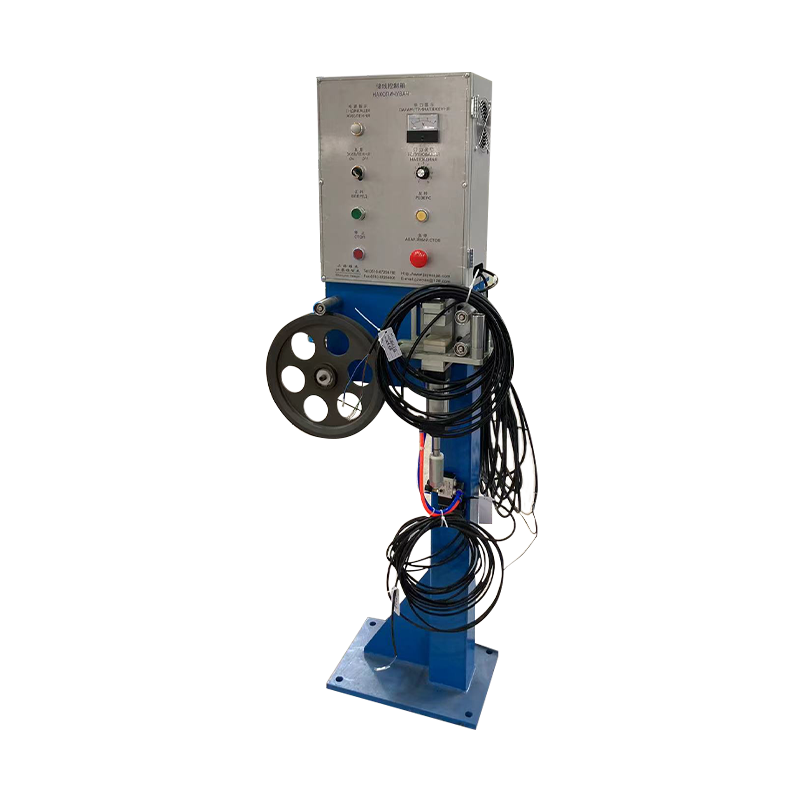
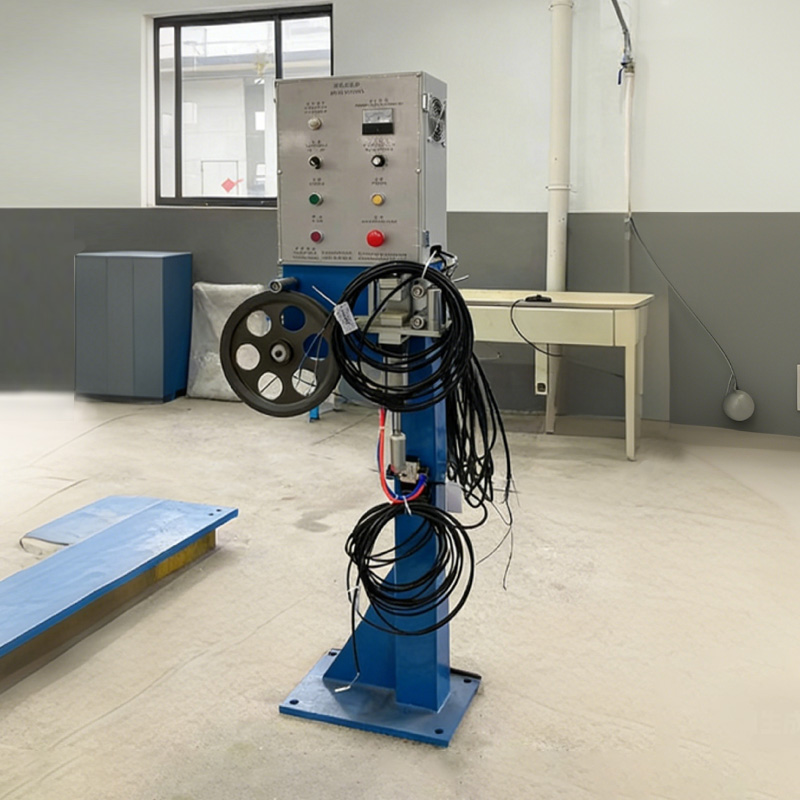 Wire Cable Tension Control SystemsDesigned for precise cable tension regulation, the Wire Cable Tension Control Systems are essential equipment for cable winding processes. Its core function lies in re...View Product →
Where Control Effort Pays Off Most, by Cable Type
Control investment returns differ sharply by product family, because material cost, tolerance and line speed differ.
Power cable, XLPE MV and LV - 38%
LAN and datacom - 26%
Building wire, PVC and UPVC - 16%
Automotive and electronic wire - 12%
Specialty and other - 8%
XLPE power cable dominates the return because wall tolerances are tight, the compound is expensive and a scrap kilometre costs several times what a scrap kilometre of PVC building wire costs. LAN cable comes second because capacitance and eccentricity limits cannot be met by operator skill alone; a 5 percent eccentricity ceiling needs continuous measurement and correction. Building wire is more forgiving on eccentricity but runs at 600 to 1200 m/min, where speed regulation and take-up tension determine whether the spool is sellable. Automotive and electronic wire rewards control mainly through repeatability across many short runs.
Commissioning Sequence: Six Steps That Lock the Settings In
A new or rebuilt line reaches stable control faster when the sequence below is followed, rather than tuning everything at once.
Step 1: Baseline before changing anything
Log melt pressure, hot and cold diameter, wall thickness and take-up tension at one-second intervals for a full shift. This record is the only reliable proof that a later change helped.
Step 2: Mount sensors for the process, not the cabinet
Place the laser gauge 6 to 8 m from the die so the melt has settled, keep the pressure transducer ahead of the screen pack, and mount the load cell where web friction cannot bias it.
Step 3: Tune loops in order
Temperature first, then melt pressure, then dimension, then tension. Tuning tension before temperature is stable simply moves the oscillation around the line.
Step 4: Build a speed ratio table
Record screw rpm against line speed for every size and compound. Operators who start from a known ratio reach saleable product in one third of the time.
Step 5: Write the changeover routine
Fill the accumulator, park the dancer at mid-travel, splice, then release storage gradually. The routine is what keeps the extruder turning while the take-up swaps.
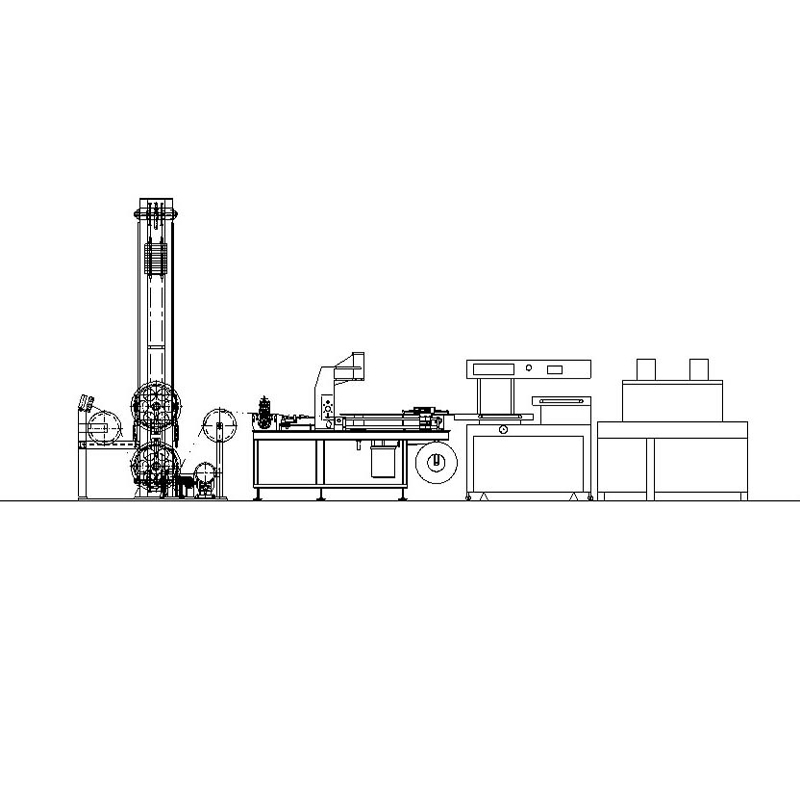 Accumulator Dancer(cable storage rack)The Accumulator Dancer (Cable Storage Rack) is a professional cable management device engineered to optimize cable processing workflows. Available in vertical and hori...View Product →
Step 6: Hand over with limits in writing
Control limits, alarm thresholds and the action each alarm requires should be on one sheet at the line, not in a commissioning file.
Maintenance, Calibration and Compliance
Control quality decays quietly. A calibration and inspection plan keeps the loops trustworthy between overhauls.
- Verifying thermocouples quarterly against a reference, with a tolerance of 5 degrees C.
- Zeroing the melt pressure transducer monthly and recalibrating it every 12 months.
- Checking the laser diameter gauge against a traceable master every 6 months.
- Calibrating dancer position and tension load cells annually.
- Measuring screw and barrel clearance every 4,000 to 6,000 running hours.
- Retaining control parameter records per production lot, as customer and standard requirements demand.
Compliance is largely a documentation exercise once the hardware is right. Cable standards such as IEC 60227, IEC 60502, UL 44, UL 83 and GB/T 5023 define the dimensions that must be met; the process control system produces the evidence that they were met on every metre. Keeping diameter and wall thickness logs per lot turns an audit into a file retrieval instead of a re-test.
Safety belongs in the same plan. Guarding on rotating take-up equipment, interlocked emergency stops and controlled access to the die head during purging are not optional extras on a line that runs unattended overnight. Alarm limits should also be set so operators react before scrap appears, not after the spool is finished.
Extrusion process control is best judged at the end of the line. An extruder that hands a variable core to the coiler has simply moved the problem downstream, where it becomes a tension fault, an oval spool or a rejected pallet. That is why measurement has to follow the product: diameter and wall thickness at the die, tension and length at the coiler, and reel identity at the point where robotic palletizing systems for cable reel handling take over.
Jiangsu Yessjet Precise Machinery builds extrusion, coiling, packaging and palletizing equipment as one connected line, which matters in this context. The loops that hold diameter at the die and the loops that hold tension at the coiler have to be designed with each other in mind, and a manufacturer that supplies both ends of that chain can tune them together rather than blaming one for the other.