LANGUAGE
 中文简体
中文简体 русский
 Français
 Español
 Português
 عربى
عربى
Content
- 1 What Defines an Extrusion Grade Polymer
- 2 Extrusion Grade vs Injection Grade: A Direct Comparison
- 3 Hidden Metrics: Reading MFI Correctly for Cable Extrusion
- 4 Distribution of Extrusion Grade Polymers in Wire and Cable
- 5 A Practical Five-Step Selection Process
- 6 Maintenance and Compliance Practices That Protect the Grade
A cable processor in Southeast Asia recently swapped an extrusion-grade polyethylene compound for a cheaper injection-grade resin to save roughly US$0.12 per kilogram. The first hour of running looked normal. By the second hour, wall thickness had drifted outside tolerance, surface waviness appeared, and nearly 12 percent of that shift's output had to be stripped and re-processed. The resin was not bad; it was simply the wrong grade for an extruder.
That experience points to the conclusion this article is built around: extrusion grade polymers are not a marketing label. They are polymer formulations with higher molecular weight, a deliberately balanced molecular weight distribution, and a lower melt flow index, all engineered to hold their shape and dimensions when pushed through a die at high speed. Selecting on price alone nearly always costs more in scrap, downtime, and rejected cable than the small premium it saves.
Core conclusion
Melt strength, flow stability, and thermal resistance decide whether a material runs cleanly on an extrusion line. Injection-grade resins lack the melt strength to hold dimensional tolerance in a die, which is why extrusion grades are specified for cable insulation and sheathing.
What Defines an Extrusion Grade Polymer
Three measurable properties separate extrusion-grade polymers from their injection-grade counterparts. Once these are clear, the rest of material selection becomes more predictable.
- Molecular weight and distribution: Extrusion grades sit at the higher-molecular-weight end of a resin family. Longer polymer chains give the melt the strength to be drawn from the die and sized into a consistent insulation layer or sheath, instead of tearing or sagging.
- Melt flow index (MFI or MFR): Most extrusion-grade PE and PP resins fall in the 0.3 to 5 g/10 min range, while injection grades often run between 8 and 60 g/10 min. A lower MFI means the melt resists sagging and keeps its cross-section as it cools.
- Die swell and melt strength: Melt strength is the resistance to stretching, and die swell is the natural expansion of the melt as it exits the die. Extrusion grades keep die swell predictable, so die land length, draw-down distance, and cooling profile can be designed with confidence.
- Thermal stabilization: Extrusion compounds carry stabilizers matched to longer residence times in the barrel and higher temperature exposure at the die. This matters most for PVC and XLPE, where uncontrolled degradation creates black specks and surface defects.
Common extrusion-grade families for cable production
LDPE / LLDPE
MFI 0.5–2. Flexible and stress-crack resistant. Used for insulation and light-duty jackets in telecommunication and building wire.
HDPE
MFI 0.3–1.5. Stiff with high tensile strength. Used for ducts, conduit, and heavy-duty outer jackets.
PVC
K-value 65–75 for flexible formulations. Inherently flame-retardant and easily plasticized. The default for low- and medium-voltage sheathing.
PP
MFI 0.5–3. Low density, good chemical resistance. Common in automotive cable insulation and filler tape.
XLPE
Cross-linkable PE compound with MFI of about 1 before curing. High dielectric strength and 90°C continuous rating. Standard for medium- and high-voltage insulation.
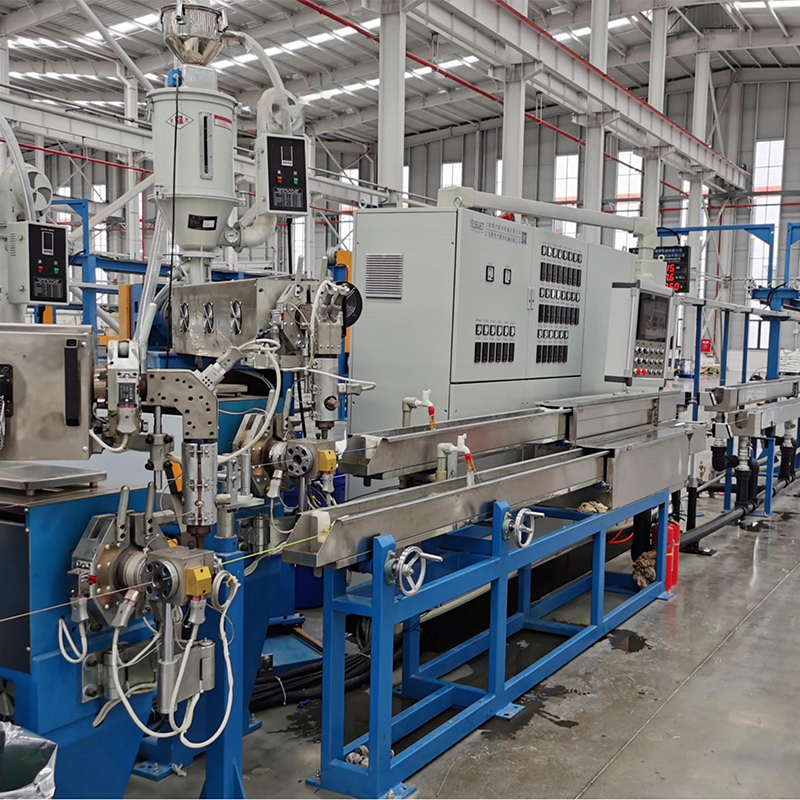
Because PE and PVC account for most cable extrusion volume by tonnage, the extruder configuration matters as much as the compound chemistry. A machine that handles both PE and PVC without re-tooling lets a plant cut changeover time and avoid cross-material contamination. One example is the full-auto PE/PVC high-performance cable extruder, which combines a dual-purpose screw, precision temperature control, and quick barrel-release features for compound switching.
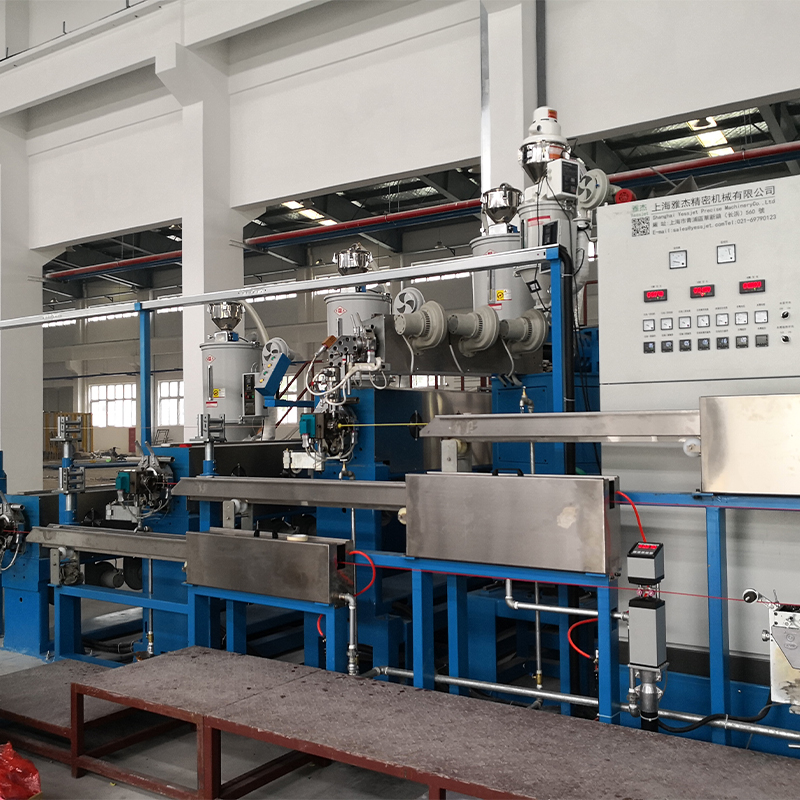 Full Auto PE/PVC High-Performance Cable Extruder with Dual-Purpose ScrewThis extruder supports fast switching between PE and PVC without re-tooling, combining a dual-purpose screw and precise temperature control. It suits plants aiming to reduce changeover time and contamination risk.View Product →
Extrusion Grade vs Injection Grade: A Direct Comparison
The comparison below shows the practical differences that affect a cable production line. Numbers assume a PE or PP resin family; PVC is normally rated by K-value instead of MFI.
Property
Extrusion Grade
Injection Grade
Effect on Production
MFI (g/10 min)
0.3–5
8–60
Dimensional control after the die
Melt strength
High
Low to moderate
Prevents sagging and neck-in
Die swell behavior
Predictable
Varies widely
Wall thickness uniformity
Molecular weight distribution
Tailored, often bimodal
Narrower
Balance of output and stability
Thermal stabilizer loading
Extended
Standard
Resists degradation during residence
Price premium
Baseline +5% to +15%
Baseline
Lower scrap rate offsets premium
Values are typical reference ranges for cable extrusion compounds. Always verify against the supplier's technical datasheet.
In practice, the premium for an extrusion grade is recovered if even one or two percent less scrap is produced. A 12 percent scrap event, as in the opening example, costs far more than any material saving.
Hidden Metrics: Reading MFI Correctly for Cable Extrusion
A spec sheet's MFI number describes how the polymer flowed in a standard die at a fixed load, not how it behaves in your screw and die combination. The chart below shows typical extrusion-grade MFI values for polymers that dominate cable insulation and sheathing. PVC is omitted because it is rated by K-value.
LDPE 0.8
LLDPE 1.0
HDPE 0.5
PP 1.5
XLPE 1.0
Typical melt flow index in g/10 min for extrusion-grade cable polymers. PVC is rated by K-value and not shown.
The hidden metric behind MFI is melt temperature stability. If the extruder cannot hold melt temperature within ±3°C at the die, even a correctly specified grade will show diameter variation. Screw geometry, barrel cooling, and upstream tension control all feed into that stability. For lines that must run continuously through reel changes, accumulator and dancer systems for continuous extrusion lines hold tension and speed steady so the extruder sees a constant load.
Distribution of Extrusion Grade Polymers in Wire and Cable
Cable makers rarely use all polymer families equally. The distribution below reflects typical consumption across the wire and cable sector.
PVC – 34%
XLPE – 26%
LDPE / LLDPE – 18%
HDPE – 8%
PP – 10%
Others – 4%
PVC leads because it is inexpensive, inherently flame-retardant, and easy to process at moderate temperatures, which makes it dominant in building wire and low-voltage cables. XLPE follows because of its dielectric strength and higher thermal rating, around 90°C continuous in most standards, making it the default for medium- and high-voltage power cables. PE grades are the mainstay of communication cable insulation, and PP has grown in automotive wiring because of chemical resistance and low density.
Processing XLPE requires a controlled temperature profile and a water trough after the die to bring the melt temperature down quickly. That is why XLPE lines normally use a water-tank extruder configuration.
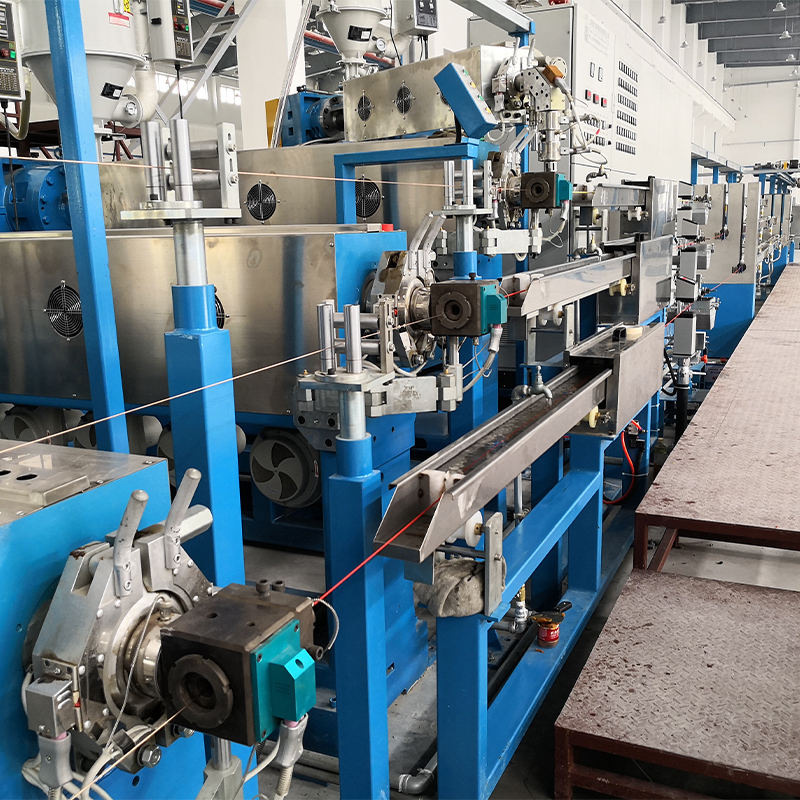 XLPE/PE Cable Extruder with Cooling Water Tank for Controlled ProcessingDesigned for XLPE and PE insulation, this extruder includes a multi-section water tank for rapid cooling and even thickness. It addresses uneven insulation and slow cooling, supporting stable electrical performance in power and communication cables.View Product →
A Practical Five-Step Selection Process
This workflow takes procurement and process engineering from a blank page to a qualified grade without guesswork.
Step 1 – Define the spec
Record voltage class, conductor size, continuous thermal rating, flame requirement, and flexibility target. This narrows the polymer field immediately.
Step 2 – Shortlist resin families
PVC for general sheathing, XLPE for power cables, PE for communication insulation, and PP where chemical resistance or weight matters.
Step 3 – Match MFI to screw and die
Low-MFI grades need more motor torque and a screw designed for higher shear; high-MFI grades need tighter die temperature control. Check L/D ratio and compression ratio.
Step 4 – Run a controlled trial
Operate at production speed and log melt temperature, head pressure, and diameter variation for at least one hour. A consistent ±1 percent diameter band is a practical target.
Step 5 – Lock the window and audit supply
Fix barrel temperatures, screw speed, and draw-down ratio in a documented procedure. Validate against IEC 60502, UL 1581, or the relevant cable standard.
The equipment is the other half of the equation. If you are planning a new plant or a major rebuild, a complete wire and cable extrusion line with a matched screw, die, cooling trough, and take-up avoids the compatibility problems that appear when machines from different suppliers are assembled on site. The extrusion line integrates those stages as a single system.
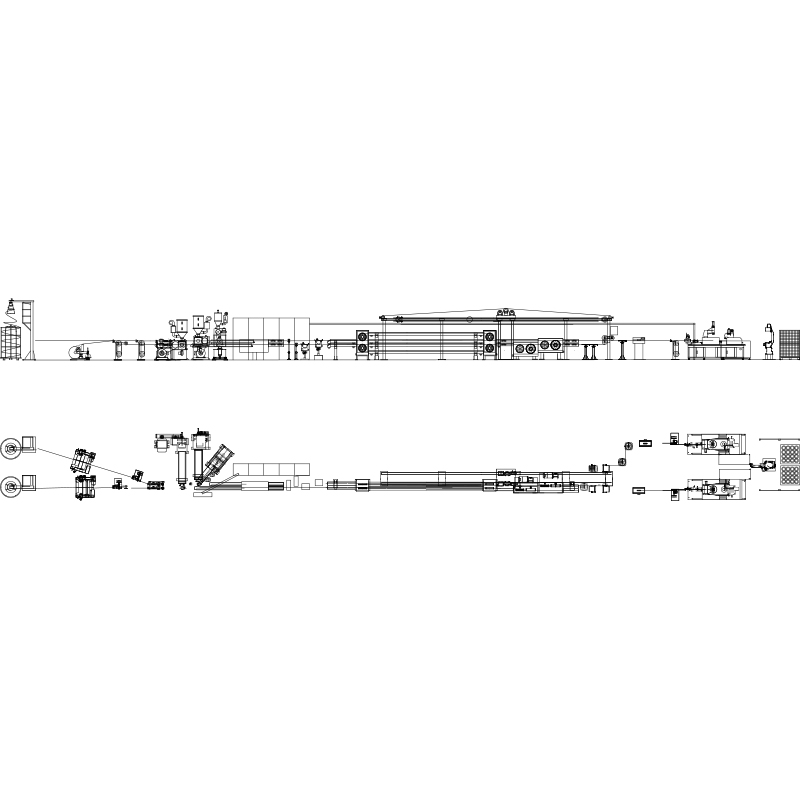 Integrated Wire and Cable Extrusion Line with Matched ComponentsThis complete line integrates pay-off, straightening, extrusion, cooling, printing, and take-up as a single system. Choosing it avoids compatibility issues from mixing suppliers, ensuring reliable operation for new plants or major rebuilds.View Product →
Maintenance and Compliance Practices That Protect the Grade
Once a grade is qualified, the biggest risks shift from selection to handling and process discipline.
Material handling and storage
- Moisture control: Even polymers with low moisture absorption develop surface splay if stored in humid conditions. Keep compounds in original sealed packaging and use a hopper dryer for hygroscopic masterbatches and specialty compounds.
- Purging between grades: Switching from PVC to PE or XLPE can leave carbonized residue that shows up as black specks hours later. Use a documented purging sequence with a compatible purge compound.
- Storage limits: Stack bags off the floor, keep warehouse temperature below 30°C, and use first-in, first-out inventory rotation to prevent fines and agglomeration.
Compliance and traceability
- Restricted substances: RoHS and REACH require documented substance declarations from the compound supplier, with periodic retesting when formulations change.
- Flame and safety standards: UL 1581, IEC 60332, and IEC 60754 define flame propagation and halogen content requirements that the chosen extrusion grade must meet for building and industrial cable.
- Batch traceability: Record polymer lot numbers, masterbatch lots, and extrusion parameters for every production run so a quality incident can be traced to material, machine, and operator.
Extrusion-grade material can still be ruined after the die by poor handling. Inconsistent coiling tension scuffs the surface, and rough palletizing can crush or distort a finished reel. Robotic palletizing systems for cable reel handling reduce that risk by automating lifting and stacking with controlled, repeatable movements. Pairing the right polymer with disciplined handling is what turns a material decision into reliable production output.