LANGUAGE
 中文简体
 русский
 Français
 Español
 Português
 عربى

Content
A 1,200 mm PP sheet line running at 15 m/min and 0.8 mm will hold ±3% across the width only when die pressure stays flat and the first chill roll pulls heat out at a constant rate. Buyers usually spend the budget on screw diameter and maximum line speed, then watch the thickness chart wander 8% from edge to centre during the acceptance run.
The difference between those two outcomes is not tonnage. It is stability, and stability is designed in at four points: melt, pressure, die and cooling.
The short version
Plastic sheet extrusion is a pressure-and-temperature process, not a screw-size contest. A 33:1 screw, a gear pump holding die pressure within roughly ±0.5%, and a three-roll stack with independent roll temperature control will beat a bigger, simpler line on yield, tolerance and start-up scrap. Specify stability first and output second; the reverse order is how most commissioning budgets disappear.
Where sheet quality is actually decided
Follow the polymer from hopper to winder and there are five control points. Each one either protects the tolerance created before it or quietly destroys it.
Melt quality
Compression ratio, flight depth and screen pack decide whether gels and unmelted particles reach the die. Hygroscopic polymers such as PET, PC and PA need dew-point drying first; moisture usually shows up as silver streaking rather than as a thickness fault, which is why it is misdiagnosed so often.
Pressure stability
A gear melt pump between extruder and die flattens the pressure pulses a screw leaves behind. Without one, every surge becomes a thickness band that travels the length of the sheet and repeats every few metres.
Die and lip
A T-die with a restrictor bar and flex lip handles coarse profiling; manual bolts handle fine correction. Automatic thermal bolts close the loop once a scanner is installed, and that upgrade alone often buys two tolerance classes.
Cooling
Roll one sets the skin, rolls two and three control gloss and flatness. Holding roll surface temperature within ±1 °C matters more for flatness than adding line speed, because uneven heat removal locks in curl that no downstream nip can remove.
Gauging
Beta or X-ray scanners read the full width; a hand micrometer checks three points and tells you whether the scanner is honest. Without a gauge, automatic die control has nothing to act on, and operators start adjusting bolts by feel.
Melt pressure and cooling carry most of the weight because both act on the entire width at once. Everything else is local correction, and local correction cannot fix a global trend.
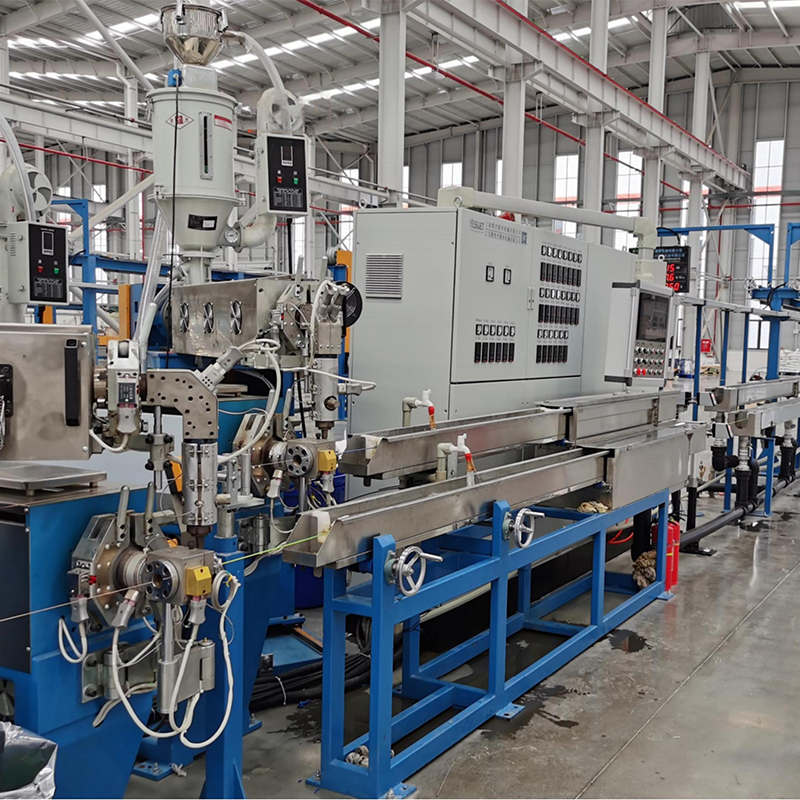
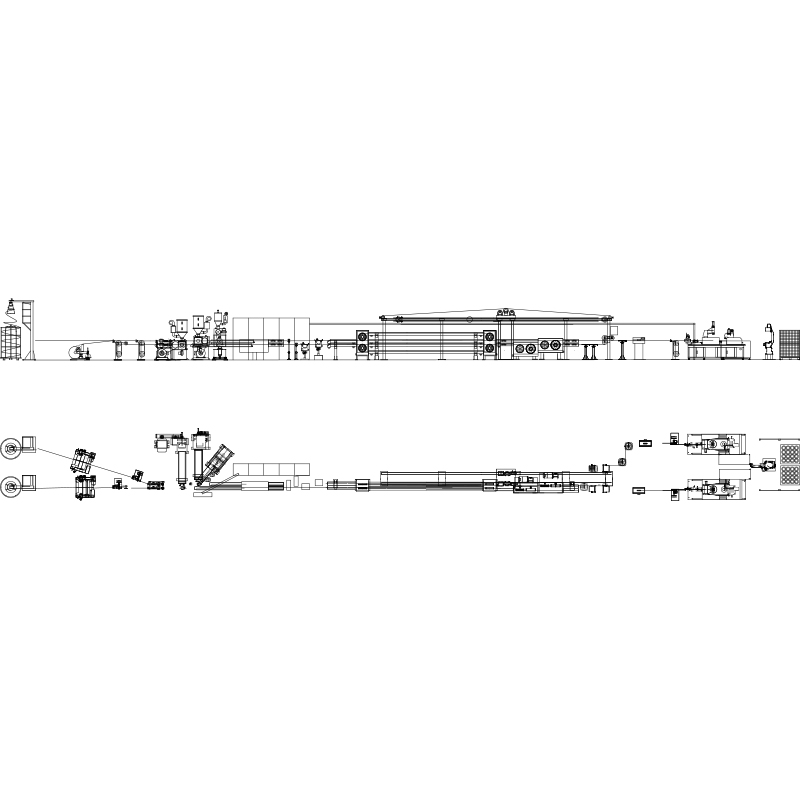
The extrusion platform itself is indifferent to the product. The screw, barrel and melt-pump logic that stabilises a 1.2 m sheet also runs on a wire and cable extrusion line, where the same pressure stability decides insulation concentricity instead of sheet gauge. Plants that run both products usually discover they can share spare screws, heaters and gauge calibration routines.
 Wire and Cable Extrusion LineAutomated line for insulated or sheathed wire and cable, with material-specific screw and barrel options, PLC control and ±2°C temperature control.View Product →
Three configurations, compared honestly
Most procurement arguments come down to three builds. The tolerance column is where the money is, and the risk column is where projects slip.
Planning ranges for 0.3–2.0 mm sheet on 90–120 mm machines running PP, PE, HIPS or rigid PVC; confirm every figure with a trial on your own compound before signing.
Where thickness variation really comes from
Across a full shift on a well-run PP line, the thickness chart has a small number of recurring causes. Their rough weight in field troubleshooting:
Die lip drift 34%
Melt temp swing 24%
Pressure surge 18%
Haul-off tension 12%
Roll runout 8%
Gauge calibration 4%
Die lip drift and melt temperature swing together account for well over half of it. Both are slow, temperature-driven effects that appear 20 to 40 minutes after a change, which is exactly why they get blamed on the screw. Watch the barrel zone readings before you touch a die bolt.
Where extruded sheet goes
Packaging 36%
Construction 22%
Electrical and electronics 15%
Automotive 12%
Agriculture 9%
Other 6%
The electrical and electronics slice — slot liners, barrier films, cable wrapping tape — is where sheet extrusion and cable manufacturing share the same equipment logic. A plant making both will usually buy one grade of drying and gauging hardware and run it across both product families rather than duplicating the controls package.
Specifying a line that pays back
1. Fix the sheet spec
Thickness range, width, tolerance class, surface finish and whether output leaves as roll or cut sheet. A ±3% target and a ±8% target lead to two different machines, not two different prices.
2. Match polymer to machine
PP, PE and HIPS run comfortably on a single screw. PET, PC and PA need drying and often a vented barrel. PVC powder prefers a twin screw with a short, controlled residence time.
3. Size output from arithmetic
kg/h ≈ width in metres × thickness in mm × line speed in m/min × density × 60. A 1.2 m wide, 0.8 mm PP sheet at 15 m/min works out near 790 kg/h, which usually shows the cooling stack, not the extruder, is the real constraint.
4. Design the downstream
Winder tension, edge trim, regrind loop and roll handling. On continuous lines, accumulator and dancer systems absorb the interruption when a finished roll is changed, so the extruder never stops and never restarts cold.
5. Run an eight-hour acceptance
Log thickness every 15 minutes across the full width, record specific energy in kWh/kg and count start-up scrap in kilograms. Specific energy between 0.25 and 0.40 kWh/kg is healthy; 0.45 and above usually means over-cooling or a worn screw.
Downstream handling quietly decides the yield
Sheet that meets tolerance and then picks up handling damage is scrap with extra steps. Winding tension, edge quality and roll wrap protection are where the last few percent of yield sit, and they are the same problems cable plants solve at the end of a jacketing line. A practical reference for the winding stage is this automatic coiling machine guide, which covers tension and coil geometry in the same terms sheet winders use.
Because sheet leaves as a cylindrical roll, wrapping and palletizing equipment designed for circular objects transfers directly. A turntable or ring wrapper with a controlled overlap keeps the outer laps clean during transport, and pneumatic or robotic handling removes the manual lift that causes most edge damage on heavy rolls.
 Auto-Wrapping Machine for Circular ObjectsSemi-automatic wrapper for wire coils, with touch-screen control, PLC-stored recipes and automatic fault alarms; manual loading keeps it suited to varied coil runs.View Product →
Palletizing is the last place to lose money. Rolls stacked by hand are stacked inconsistently, and inconsistent stacks fail in transit. A robotic stacker with a designed pattern and layer count pays back fastest on lines above roughly 500 kg/h, where a two-person stacking crew becomes the throughput bottleneck.
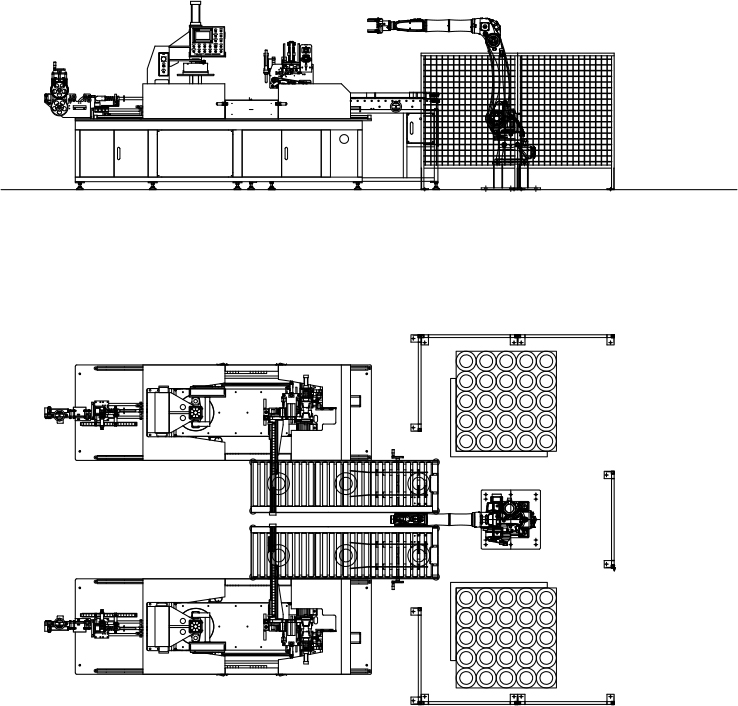 Intelligent Robot Stacker for Coil PalletizingRobotic stacking system for cable coils and other handling tasks, with touch-screen control, configurable coils per stack, custom conveyor dimensions and automatic completion alerts.View Product →
Maintenance and compliance that protect the tolerance
- Measure screw and barrel clearance annually. Wear beyond about 0.3 mm shows up first as falling output, then as surging pressure that no die adjustment can hold.
- Clean die lips with brass or copper tools only. A steel scraper leaves a scratch that becomes a permanent thickness stripe on every roll.
- Service chill roll water channels on schedule; scale build-up creates a cold band that reads as a die fault but is really a flow fault.
- Verify the scanner weekly against a hand micrometer at three points across the width. A drifting gauge quietly drags the whole line out of tolerance.
- Cap regrind at 20–30% for non-critical sheet, keep dust out of the blend, and re-dry regrind of hygroscopic polymers as if it were virgin material.
- For food-contact sheet, keep material declarations aligned with EU 10/2011 or FDA 21 CFR 177 and retain lot traceability from resin to roll.
- Guard every nip and interlock every access panel; fume extraction on PVC is a compliance item as much as a comfort one.
Sheet extrusion rewards buyers who treat tolerance as a system property rather than a machine specification. Check the pressure stability, the cooling control and the downstream handling first, then compare screw diameters — and insist on an eight-hour acceptance run with a printed thickness log before the final payment.