LANGUAGE
 中文简体
 русский
 Français
 Español
 Português
 عربى

Content
- 1 What Thermoplastic Elastomers Are and Why the Name Misleads
- 2 The Processing Window: Where TPE Projects Succeed or Fail
- 3 TPE vs. PVC, Silicone and Thermoset Rubber: What Changes on the Line
- 4 The Hidden Cost Drivers Buyers Usually Miss
- 5 Where TPE Volume Goes and What It Means for Cable Equipment
- 6 A Practical Selection and Commissioning Flow
- 7 Maintenance and Compliance Notes for TPE Lines
Bottom line: Thermoplastic elastomers (TPEs) are not drop-in replacements for PVC or thermoset rubber. A cable line that runs PVC at 70 Shore A will not automatically run a 70 Shore A TPE compound at the same speed, tension or coiling pressure. The material’s hard and soft phases change melt behavior, cooling demand and compression set, so the extruder, cooling trough, capstan, accumulator and coiler must be reviewed as one system.
A plant changes a flexible control cable jacket from PVC to a TPE compound and expects the same line speed. Three shifts later, the coiler is crushing the product, the extruder is surging, and the scrap bin is full. The compound may be fine. The line settings and downstream handling usually are not.
This is why cable equipment teams, including ours at Yessjet, treat TPE as a process project rather than a material swap. The useful questions are practical: what polymer family is in the compound, how wide is its processing window, how much drying does it need, and what happens to tension and compression when the product leaves the die?
What Thermoplastic Elastomers Are and Why the Name Misleads
TPE is an umbrella term, not one recipe. It covers block copolymers and physical blends that behave like rubber at use temperature but can be softened and reshaped by heat. The rubber-like behavior comes from soft segments or a dispersed rubber phase; the thermoplastic behavior comes from hard segments or a continuous plastic phase. Those phases are held together by physical crosslinks, not by the covalent crosslinks found in thermoset rubber.
TPS / SEBS
Soft, flexible and easy to color. Often used in flexible cords and consumer cable jackets, but creep and oil resistance need checking.
TPV
A rubber phase dispersed in a thermoplastic matrix. Good compression set and heat resistance make it common in automotive and industrial cable applications.
TPU
Tough, abrasion-resistant and often chosen for robotic, charging and mobile cable jackets. It is hygroscopic and usually needs careful drying.
TPO, COPE, PEBA
Specialty families with different temperature, chemical and flex-fatigue profiles. The datasheet, not the abbreviation, decides the line setup.
The practical consequence is that “TPE” tells a buyer almost nothing about extrusion behavior. Two compounds with the same hardness can have different melt viscosity, moisture sensitivity, die swell and cooling rates. A useful specification therefore includes the polymer family, hardness tolerance, tensile strength, elongation, compression set, service temperature and recommended drying conditions.
The Processing Window: Where TPE Projects Succeed or Fail
TPE extrusion is less forgiving than PVC in several places. The material may be shear-sensitive, the melt may have a narrow temperature band, and moisture can create silver streaks or bubbles. The line must control heat history from the hopper to the die, not just barrel temperature.
- Drying: TPU and some TPS grades need dehumidified air. A hopper dryer without dew-point control may not be enough.
- Melt temperature: Use a melt probe and a recipe that records actual melt, not only set-point zones.
- Cooling: TPE often needs gentler, longer cooling to avoid internal stress and surface marking.
- Tension: Soft compounds elongate under tension; capstan and accumulator settings must be tuned to the grade.
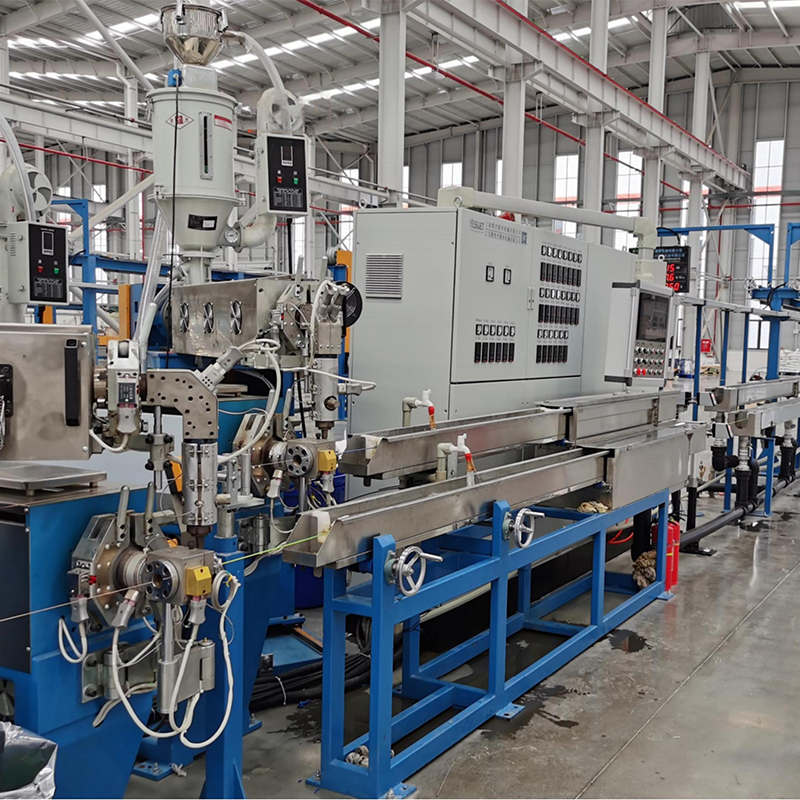
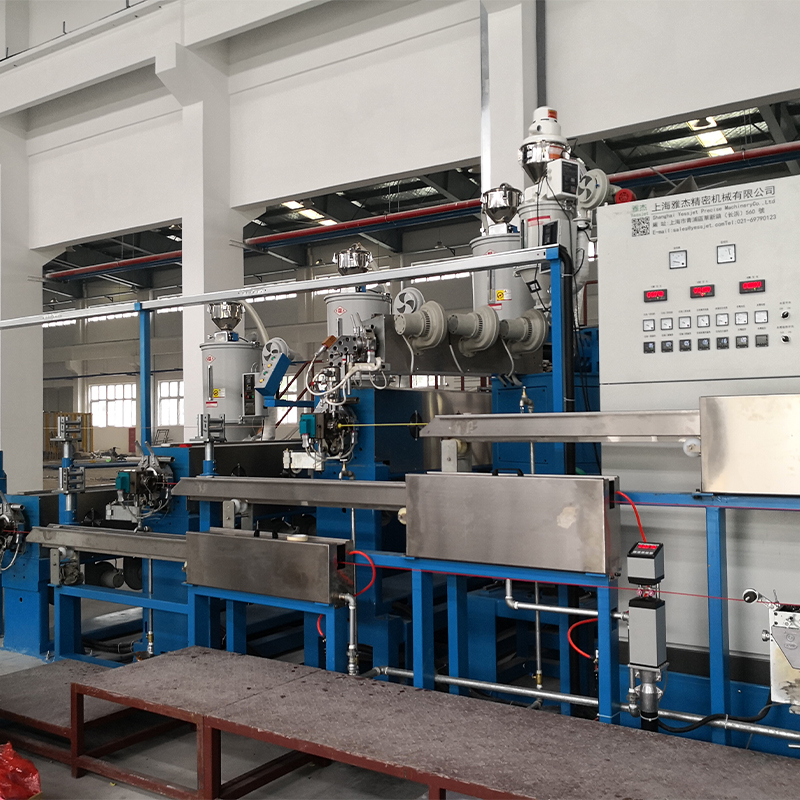 Full Auto PE/PVC Cable Extruder for Continuous Insulation ProductionIntegrated automatic pay-off, precision extrusion, cooling and haul-off system for stable PE/PVC insulation and jacket production with PLC control and ±0.03 mm tolerance.View Product →
On continuous extrusion lines, the accumulator is not a buffer only for changeovers. It also protects the product from tension spikes. For TPE jackets, that protection matters more because the material can yield before the operator sees a visible defect. Accumulator and dancer systems for continuous extrusion lines should be sized around the compound’s elasticity, not only the line speed.
The same logic applies downstream. A coiler that works for rigid PVC may apply too much side pressure to a soft TPE. The result is an oval coil, blocked layers or a jacket mark that appears only after storage.
TPE vs. PVC, Silicone and Thermoset Rubber: What Changes on the Line
The table below is a selection aid, not a grade datasheet. Values vary by compound, filler, flame-retardant package and hardness. Use it to ask better questions before a trial run.
Typical ranges for cable-grade compounds; confirm all values with the compound supplier before setting line parameters.
Property
TPE
PVC
Silicone
Thermoset rubber
Hardness
30–90 Shore A
50–95 Shore A
20–80 Shore A
40–90 Shore A
Density
0.9–1.3 g/cm³
1.2–1.5 g/cm³
1.1–1.3 g/cm³
1.0–1.3 g/cm³
Tensile strength
5–25 MPa
10–25 MPa
5–10 MPa
10–25 MPa
Elongation
300–700%
200–400%
100–400%
200–600%
Service temperature
-40 to 125°C
-10 to 70°C
-50 to 200°C
-40 to 150°C
Reprocessable
Yes, with care
Yes
No
No
For a cable plant, the key difference is not “rubber versus plastic.” It is how the material behaves under heat, tension and compression. TPE may allow shorter cycle times than thermoset rubber, but it can demand tighter moisture control and gentler winding than PVC.
The Hidden Cost Drivers Buyers Usually Miss
Purchase price is a poor predictor of TPE line cost. The larger effects often sit in drying, changeover, tension stability, cooling length and coiling yield. The chart below is an illustrative relative sensitivity index from cable process reviews, not a benchmark from one plant.
Drying
Melt temp.
Tension
Cooling
Coiling
Changeover
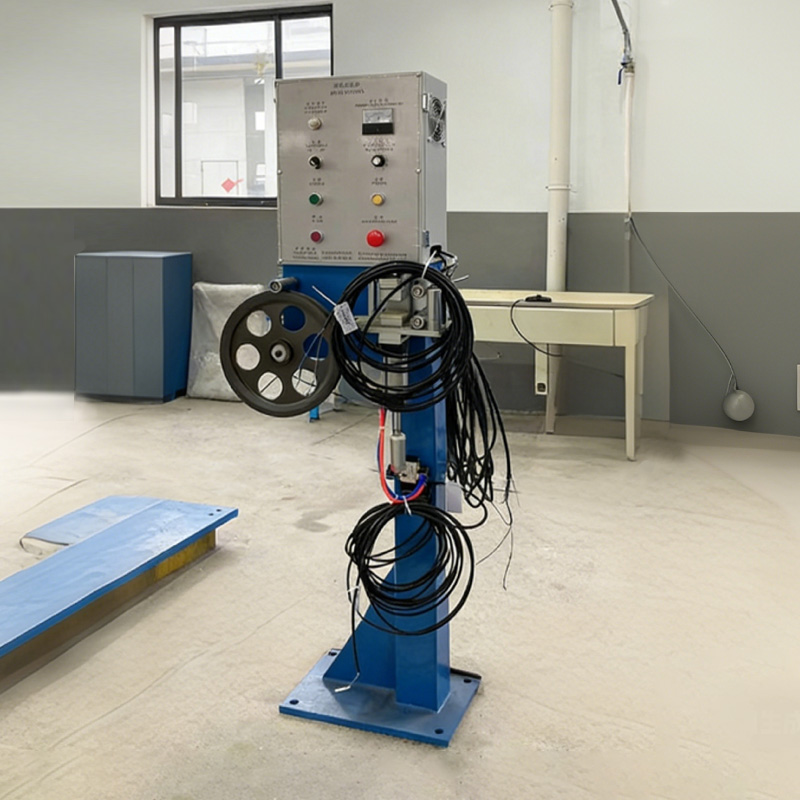 Wire and Cable Tension Control System for Stable WindingReal-time tension regulation for cable winding that helps prevent stretching, loose coils and disordered arrangement, supporting consistent quality and reduced waste in cable production.View Product →
Tension and coiling are often underestimated because defects appear late. A line may look stable at the die, then produce rejected coils after 24 hours of storage. Closed-loop tension control and a coiler recipe tuned to the compound’s elasticity reduce that risk more reliably than simply slowing the line.
Where TPE Volume Goes and What It Means for Cable Equipment
TPE demand is broad, but not every application has the same equipment requirements. Automotive, consumer electronics and medical products absorb most volume; wire and cable is a smaller share, yet it includes demanding flex, abrasion and temperature requirements.
Automotive 35%
Consumer and electronics 25%
Medical 15%
Construction and industrial 15%
Wire and cable 10%
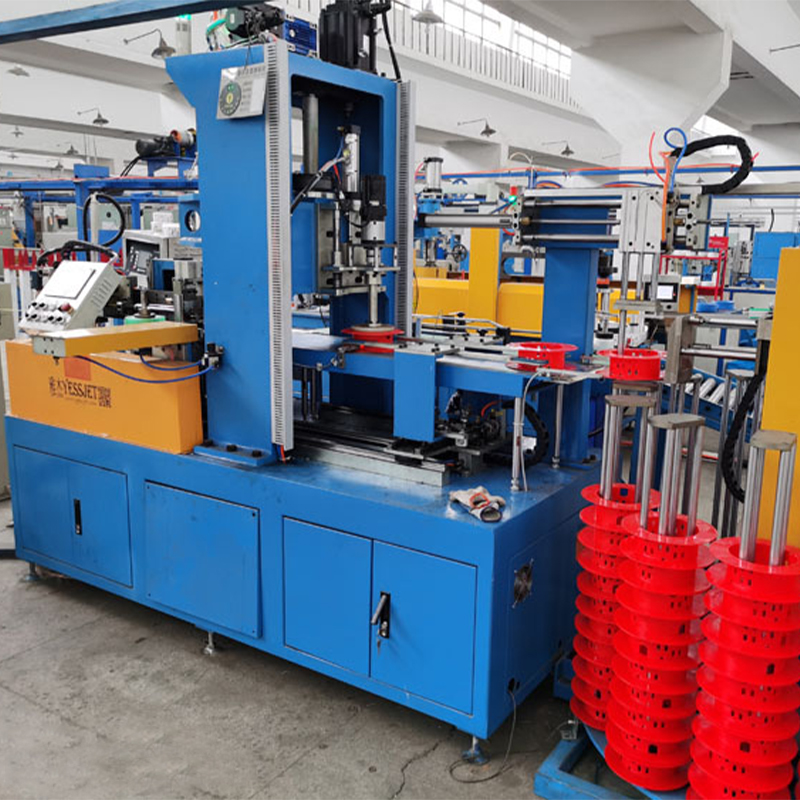
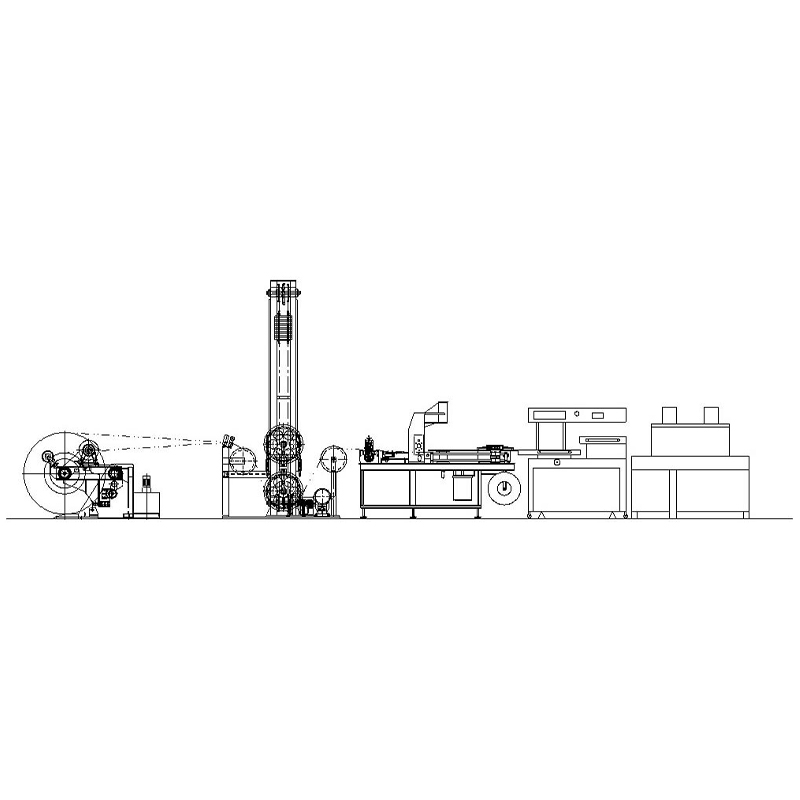 Automatic Wire and Cable Coiling and Wrapping MachineAutomated coiling and wrapping for wires and cables, with label feeding, servo traversing, fault alarms and PLC storage for 99 coil recipes, reducing manual packaging.View Product →
In cable production, TPE is common in flexible cords, charging cables, robotic cable, medical cable and automotive wire. These products often share a need for stable tension, low compression set and a clean coil. For reel handling at the end of the line, robotic palletizing systems for cable reel handling can reduce manual lifting, but only if the coil and reel are stable enough to stack.
A Practical Selection and Commissioning Flow
A TPE project moves faster when the material, line and end-of-line handling are tested together. The following flow keeps purchasing risks visible before a full production run.
01
Define the property profile
Write hardness, temperature, flex and chemical requirements before comparing compounds. Include the cable construction, not only the jacket material.
02
Run a pilot extrusion
Record melt temperature, pressure, screw speed, line speed and cooling profile. Check die swell and surface quality at three speeds.
03
Tune tension and coiling
Test the accumulator, capstan and coiler with the actual compound. Store coils for 24 hours and inspect for flattening or layer blocking.
04
Validate packaging and stacking
Confirm that the wrapped coil keeps its shape and that the reel can be handled by the palletizing system without deformation.
ROI usually comes from three places: less startup scrap, shorter changeover between TPE grades, and fewer rejected coils. A lower-priced compound that needs extra drying time or causes frequent coiler stops can erase the savings before the first shipment.
Maintenance and Compliance Notes for TPE Lines
- Check dryer dew point and hopper seals regularly; moisture defects often look like extrusion defects.
- Inspect screw and barrel wear when running filled or flame-retardant TPE compounds; wear changes melt temperature stability.
- Keep a grade-specific recipe for each compound, including cooling and coiling pressure, not only extruder zones.
- Verify compliance claims for RoHS, REACH, UL or medical standards against the actual compound certificate, not the generic TPE label.
Recyclability also deserves a careful claim. TPE is thermoplastic and can be reprocessed, but a finished cable with fillers, flame retardants and mixed layers may not fit a closed-loop recycling stream. Buyers should separate “reprocessable” from “recyclable in this product.”
The safest way to evaluate thermoplastic elastomers is to start with the compound datasheet and end with a full-line trial. If the extruder, tension control, coiling and packaging are treated as separate purchases, the material gets blamed for problems created at the interfaces. If they are commissioned together, TPE can deliver the soft feel, flexibility and design freedom that cable customers expect, without turning the line into a scrap generator.