LANGUAGE
 中文简体
 русский
 Français
 Español
 Português
 عربى

Content
- 1 What the screw is actually doing inside the barrel
- 2 Comparing screw designs on the numbers that decide output
- 3 What the datasheet leaves out: where output quietly goes
- 4 Where these machines sit in cable production
- 5 Specifying a screw extruder: a five-step check
- 6 Keeping the screw honest: maintenance and compliance
A 90 mm extruder rated at 380 kg/h for PVC sheathing often settles at 330 kg/h once the line runs three shifts on a compound with a heavier filler load — and the operator blames the die, the vacuum pump, or the screw. In most specification reviews we sit in on, the mismatch was locked in months earlier, when a screw geometry was picked for one compound and the line was later asked to run another.
The short version
Screw extruders are chosen by compound and line speed, not by nominal tonnage. PVC insulation and sheathing sit comfortably on a 20–24:1 L/D single screw with a 2.5–3.5 compression ratio. PE and XLPE insulation at high line speed needs grooved feed, 25–30:1 L/D and a barrier section to hold melt temperature flat. Match those three variables and most diameter-drift and output-stability complaints are answered before the first drum of compound is opened.
What follows is how the geometry maps onto a cable line, which numbers belong in a purchase specification, and the checks that keep output stable in year three.
What the screw is actually doing inside the barrel
A single screw does three jobs in one rotation: it conveys cold granulate, melts it against the heated barrel wall, and pumps the melt through a breaker plate into the crosshead at a pressure steady enough to hold wall thickness. Each job lives in its own zone, and each zone is defined by flight depth.
Feed zone
Deep flights, roughly 0.12–0.18 D. Its task is volumetric conveying, so output follows granulate bulk density and pellet shape. This is the zone a grooved barrel is designed to stabilise.
Compression zone
Flight depth tapers from feed to metering depth. The ratio between the two is the compression ratio; too low and unmelted particles reach the die, too high and shear heating adds 15–25 °C to the melt.
Metering zone
Constant shallow depth, typically 5–8 D long. It is the pump, and its pressure stability influences diameter tolerance more than any downstream control loop.
Breaker plate and crosshead
Screen packs build 15–30 MPa of back pressure. A pressure die handles insulation, a tube die handles sheathing; the screw decides how steadily either one is filled.
Downstream, the geometry stops mattering if the rest of the line cannot keep up. On an XLPE insulation line the wire and cable extrusion line has to balance barrel temperatures, trough cooling length, capstan tension and take-up speed in one setpoint window, and the screw is only the first link in that chain.
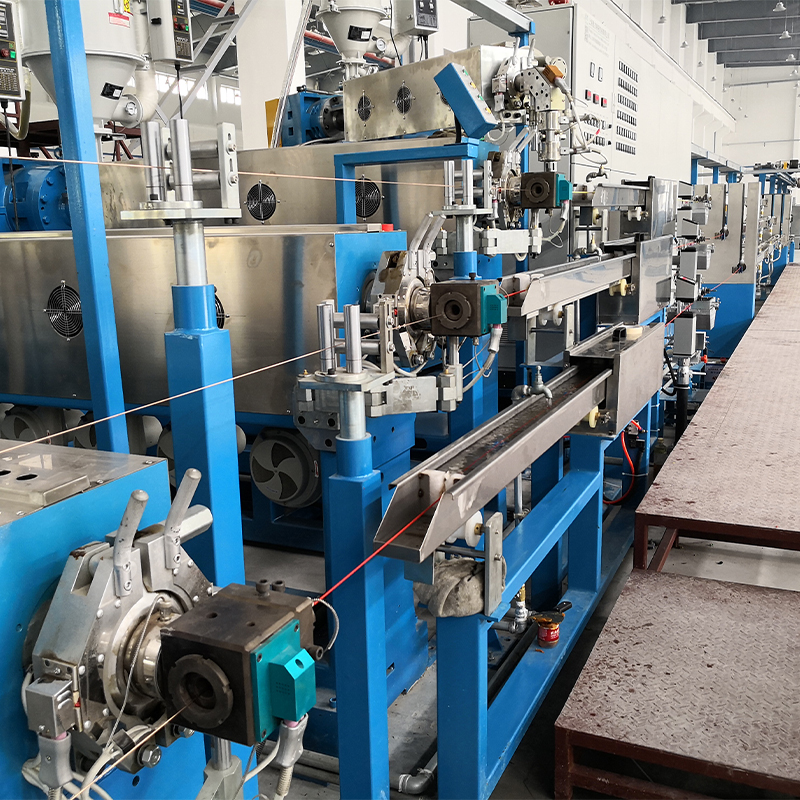
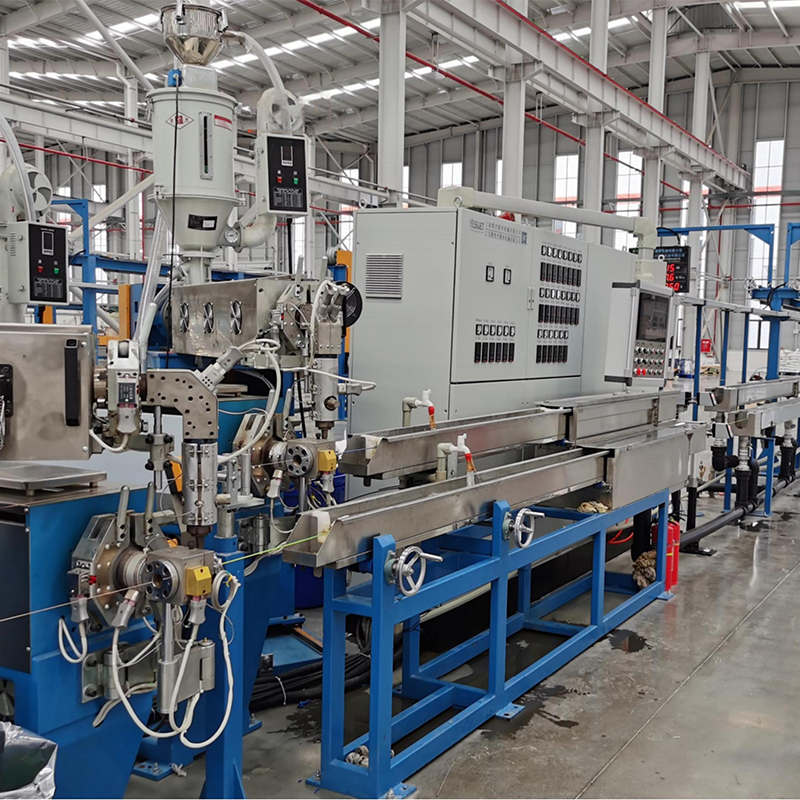
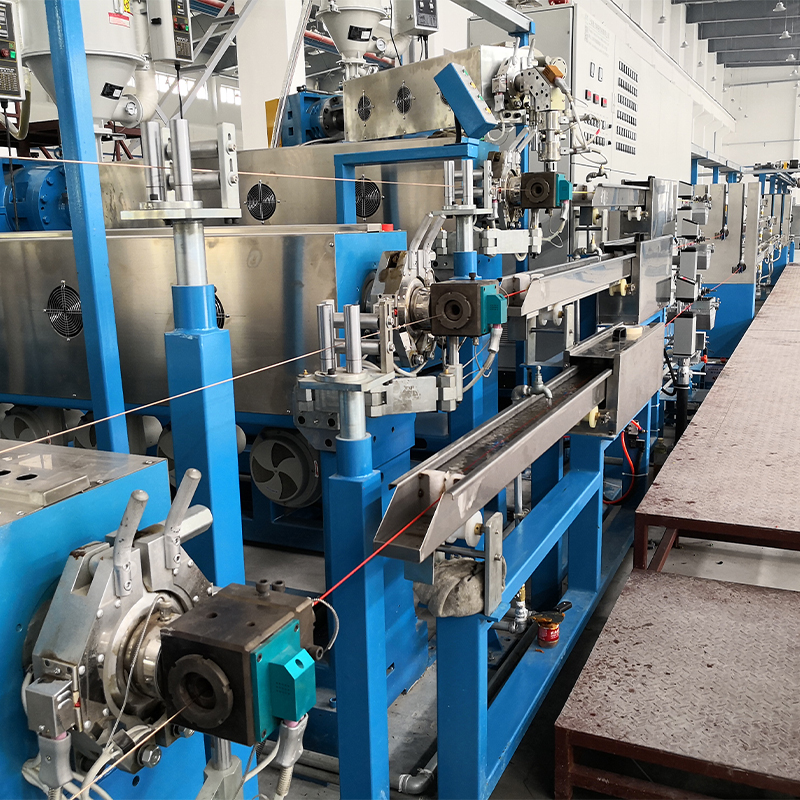 XLPE/PE Cable Extruder with Cooling Water TankFor crosslinked PE lines where melt cannot be reworked, this integrated extruder and multi-section water tank supports continuous insulation with controlled cooling and stable output.View Product →
Crosslinked PE raises the stakes because the melt cannot be reworked. A dedicated PE/XLPE machine with a matched water trough keeps the melt in a narrow band and prevents premature crosslinking inside the barrel, which is the failure mode that shows up as gel spots three days into a production run.
Comparing screw designs on the numbers that decide output
When two suppliers quote the same diameter, the difference sits in L/D, compression ratio and feed design. The ranges below are the ones we compare most often during a technical review.
Indicative ranges drawn from cable-line specifications; always confirm against a shop test on your own compound before signing.
Twin screw machines dominate PVC dry-blend work because intermeshing flights are self-wiping and convey powder without a pre-compounding step. On insulation lines the single screw still wins on melt-pressure stability and cost per kg/h, which is why the choice is usually made on the compound rather than the screw count.
What the datasheet leaves out: where output quietly goes
Nameplate output is measured with a new screw, a clean screen pack and a settled feed throat. Real lines lose throughput in five predictable places, and only one of them is the motor.
14%
Flight clearance
9%
Screen pack creep
7%
Die restriction
6%
Throat drift
4%
Heater band
Indicative throughput loss contribution measured across a two-year window on a 90 mm insulation line.
Flight clearance is the silent one. A new 90 mm screw typically runs at 0.20–0.30 mm radial clearance; past roughly 0.45 mm the melt slips back over the flights, output falls and melt temperature climbs at the same setpoints. Because nothing alarms, the drop is blamed on the compound. Screen pack pressure creep hides the same way: a rising differential pressure reading across the breaker plate is your earliest warning that the pump is working harder than it should.
Where these machines sit in cable production
Across the cable plants we supply, the split below reflects how extruder capacity is actually distributed by end product rather than by machine size.
PVC insulation and sheathing — 38%
PE and XLPE power cable — 31%
LSZH and fire-resistant — 14%
LAN and communication — 11%
Specialty and foam — 6%
The application matters because it changes what the line must do when it stops. Sheathing lines tolerate a short stop for a reel change; fine-wire and LAN lines do not, and that is where accumulator and dancer systems for continuous extrusion lines earn their place, holding a buffer of cable and a constant tension while the downstream reel is swapped.
Specifying a screw extruder: a five-step check
A purchase specification that survives commissioning usually follows the same order of decisions.
Step 1 — Fix the compound before the tonnage
Record melt index, filler load, permitted melt temperature ceiling and wall thickness range. Two compounds that look similar on a data sheet can demand a 4:1 difference in compression ratio.
Step 2 — Size output at the die, not on the nameplate
Take the kg/h required at the crosshead at your maximum line speed and add 15% headroom for compound variation and screw wear.
Step 3 — Decide the feed design
Grooved feed buys stable output with free-flowing PE granulate; smooth bore is more forgiving of regrind and light PVC blends.
Step 4 — Check the drive and gearbox
Ask for the torque curve at the low end of the speed range and a gearbox service factor that survives a stalled screen pack, not the steady-state load.
Step 5 — Write the acceptance test
Four continuous hours on your compound, with logged melt temperature, diameter tolerance, specific energy in kWh/kg and a screw withdrawal measurement before handover.
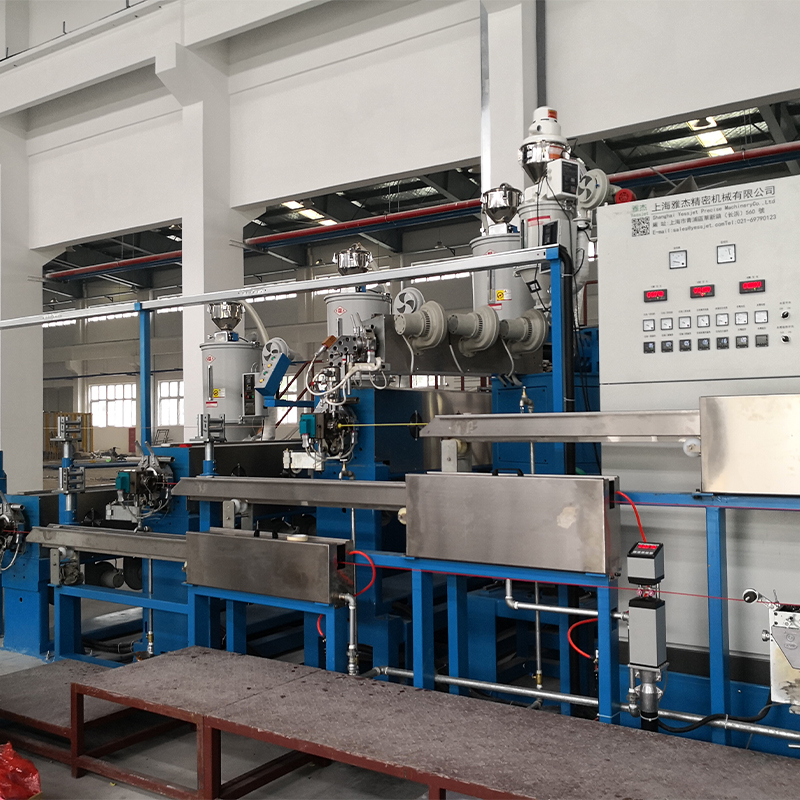 Full-Auto PE/PVC High-Performance Cable Extrusion SystemWhen planning a new PE/PVC cable line, this integrated system covers automatic pay-off, precision extrusion, cooling, haul-off and take-up to reduce manual intervention.View Product →
Where a new line is being planned rather than a single machine replaced, the useful question is who owns the interfaces — barrel temperatures, capstan tension, coiling and palletising — because mismatched handovers are where most ramp-up delays originate.
Keeping the screw honest: maintenance and compliance
- Measure radial flight clearance and barrel wear every 12 months; record it against the commissioning value so the trend, not the absolute number, triggers replacement.
- Log melt temperature and screen pack differential pressure each shift. A 2 MPa rise over a week is a blocked pack, not a control fault.
- Replace heater bands as a set. One weak band creates a cold spot that shows up as an unmelted streak in the insulation.
- Purge with a compound matched to the next run rather than running the barrel dry; thermal cycling is what warps flights.
- Keep documentation aligned with the market you ship to: electrical safety and guarding to recognised machinery standards, plus material and process records traceable to the cable batch.
None of this is exotic, and none of it is expensive when it is planned into the specification. The costly version is discovering in year two that the screw, the feed throat and the screen pack were each chosen by a different person against a different assumption.
The practical takeaway: treat the screw as a matched part of the compound-line system, put L/D, compression ratio, feed design and flight clearance in writing, and test all four before the machine leaves the works. That is what separates a line that holds 350 kg/h for a decade from one that needs a new screw every eighteen months.