LANGUAGE
 中文简体
中文简体 русский
 Français
 Español
 Português
 عربى
عربى
Content
- 1 Why Manual Cable Coil Labeling Fails at Scale
- 2 What Is a Cable Label Feeder
- 3 How Automatic Cable Labeling Machines Work on the Assembly Line
- 4 Cable Coil Labeling: Technical Parameters That Matter
- 5 Key Benefits of Automating Your Cable Coil Labeling Process
- 6 Integration with the Broader Cable Production Line
On a cable production line running at full capacity, a single labeling station staffed by one operator can become the bottleneck that limits throughput across the entire packaging sequence. Manual cable coil labeling is slow, inconsistent, and—when the operator is fatigued or distracted—prone to crooked placements, missed coils, and label bubbling that forces rework. For cable manufacturers scaling production volume, eliminating manual labeling is not a quality preference. It is a production engineering requirement.
This guide covers the three technologies at the center of that automation: the automatic cable labeling machine, the cable label feeder, and the specific workflow of cable coil labeling on an integrated assembly line.
Why Manual Cable Coil Labeling Fails at Scale
The problems with manual cable coil labeling become measurable once production volume reaches the point where labeling speed, not coiling speed, determines line output rate.
Inconsistent placement. A self-adhesive label applied by hand to the side face of a coil depends entirely on the operator's attention and grip angle. Label position varies by centimeters between coils. On finished product destined for retail display or automated scanning, inconsistent placement means barcodes fail to scan reliably, and the professional appearance that reflects product quality is undermined at the final stage of production.
Labor dependency and cost accumulation. Dedicated labeling operators represent a fixed labor cost that scales linearly with production volume. At output rates above 300–500 coils per shift, a single labeling station typically requires one full-time operator whose only productive output is label placement—a function that generates no added value beyond what an automated device can deliver at a fraction of the per-unit cost.
Bottleneck risk in integrated lines. When coiling, wrapping, and labeling are sequential operations on a continuous line, the slowest station determines the output rate of the whole system. Manual labeling consistently limits throughput because human application speed is not synchronized to machine coiling speed. The result is either a buffer accumulation upstream of the labeling station or deliberate line slowdown to match the operator's pace—both of which reduce the effective output of capital equipment with far higher per-unit cost than the labeling step itself.
What Is a Cable Label Feeder
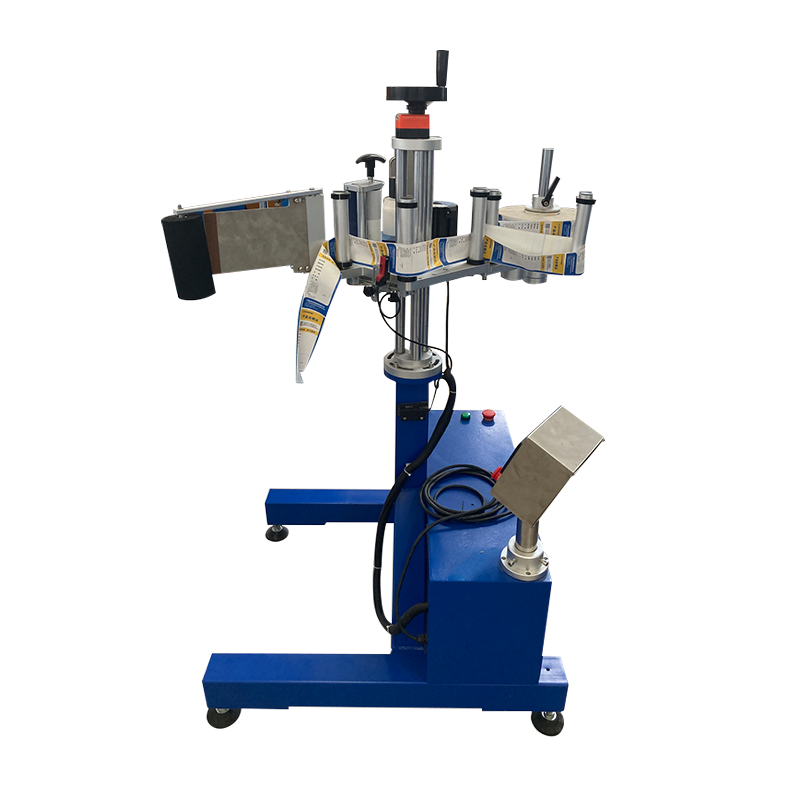
A cable label feeder is a dedicated automation device that dispenses pre-made self-adhesive labels and applies them to the side face of a cable coil as it passes through the labeling station on the assembly line. The device indexes labels from a roll, peels the backing liner, and applies each label at a defined position on the coil with consistent orientation and pressure—without operator involvement.
The key distinction between a cable label feeder and a general-purpose wire labeling machine is the application target. General wire labeling machines are designed to wrap labels around the cylindrical surface of individual wire runs—they apply the label longitudinally along the wire. A cable label feeder, by contrast, applies labels to the flat side face of a finished coil—the surface visible when the coil is standing upright or displayed on a shelf. This is the labeling requirement specific to packaged cable coil production, and it demands a different feed geometry, a different label presentation angle, and different positional accuracy relative to the coil edge.
Yessjet's Cable Stickers Label Feeder for assembly line coil labeling is engineered specifically for this application: pre-made self-adhesive labels are automatically fed and applied to the coil side on the moving assembly line, with no manual operation required at the labeling station.
How Automatic Cable Labeling Machines Work on the Assembly Line
An automatic cable labeling machine integrated into a coil packaging line operates as a synchronized station within the overall line sequence. Understanding the integration logic clarifies both what the machine can do and what upstream and downstream conditions it requires to function correctly.
Label roll feed and peel mechanism. The machine holds a roll of pre-printed self-adhesive labels on a spindle. A stepper-motor-driven feed mechanism advances the label strip at a controlled rate. At the peel point, the backing liner bends sharply around a plate edge, causing the label to separate from the liner and present itself face-up for application. The liner is then rewound onto a take-up spool, keeping the work area clear of waste material.
Coil detection and trigger. A sensor—typically a photoelectric switch positioned at the entry to the labeling station—detects the arrival of each coil on the conveyor. The detection signal triggers the label dispense cycle: the label is advanced to the application position and pressed onto the coil side face at the moment the coil reaches the defined labeling point. The trigger timing is adjustable to synchronize with conveyor speed, ensuring consistent label placement position regardless of minor conveyor speed variation.
Application pressure and conformability. The label is applied by a pad or roller that presses it uniformly against the coil face. Even contact pressure across the full label area is critical for preventing edge lift, air bubbles, and partial adhesion—all common defects in manual application. Consistent application pressure is one of the primary quality advantages of automated label feeding over hand application.
Label length accommodation. Different cable products require different label formats—barcode labels, product information labels, safety warning labels—which vary in printed length. A correctly specified automatic cable labeling machine accommodates a defined label length range without mechanical adjustment for each format. The label length range determines which cable product mix the machine can serve without a tooling change.
Cable Coil Labeling: Technical Parameters That Matter
Selecting an automatic cable labeling machine for coil-side application requires evaluating parameters that are specific to the coil labeling task and that differ from the parameters relevant to inline wire labeling applications.
| Parameter | Specification (Yessjet Cable Stickers Label Feeder) | Why It Matters |
|---|---|---|
| Labeling accuracy | ±1mm | Determines barcode scan reliability and visual consistency on finished product |
| Label length range | 50mm – 160mm | Must accommodate all label formats in the product mix without tooling change |
| Power rating | 150W (220V, 60Hz) | Low power consumption; compatible with standard production floor electrical supply |
| Machine footprint | 1100 × 870 × 2000mm | Compact footprint fits into existing line layouts without major floor plan revision |
| Machine weight | 80kg | Manageable for installation and repositioning within the production area |
| Operation mode | Fully automatic, no manual operation | Eliminates dedicated labeling operator; enables continuous unattended operation |
The ±1mm positional accuracy specification deserves particular attention. For coils carrying printed barcodes, label placement accuracy directly affects first-read scan rates at downstream checkpoints and at customer receiving. A label misplaced by more than 2–3mm from the expected position on the coil face can cause scanner misalignment failures in automated receiving systems, triggering manual intervention at precisely the stage of the supply chain where automation provides the most value.
For a complete view of the accessory equipment lineup that supports cable production workflows, see the full range of wire cable production accessory equipment covering storage, labeling, tension control, conveying, and coiling head solutions.
Key Benefits of Automating Your Cable Coil Labeling Process
The case for automatic cable labeling machines in coil production is built on measurable outcomes across four dimensions: labor, quality, speed, and traceability.
Labor cost reduction. Removing a dedicated labeling operator from the line eliminates a recurring labor cost per shift. Industry data on labeling automation indicates that companies automating labeling stations can reduce associated labor costs on labeling lines by up to 30%. For high-volume cable production running multiple shifts, this compounds into significant annual savings against the capital cost of the automated device.
Consistent quality at every coil. Automated application eliminates the variability introduced by operator fatigue, shift changes, and individual technique differences. Every coil receives the label at the same position, with the same application pressure, regardless of production volume or time of shift. This consistency matters both for finished product appearance and for downstream barcode scanning reliability.
Line speed synchronization. A cable label feeder operates at a speed determined by the conveyor rate of the production line, not by the physical capacity of a human operator. This removes labeling as a throughput-limiting bottleneck and allows the full output capacity of upstream coiling and wrapping equipment to be utilized without rate throttling at the labeling station.
Traceability and identification support. Consistent, machine-applied labels carry barcode, QR code, or sequential numbering data that enables product traceability from the packaging line through distribution to the end customer. For cable manufacturers supplying to industrial, construction, or data infrastructure customers where cable identification is a project specification requirement, machine-applied labels provide the labeling consistency that manual application cannot reliably deliver at production volume.
Integration with the Broader Cable Production Line
A cable label feeder delivers its full value when integrated as one station within a complete automated packaging sequence rather than operated as a standalone device. The typical coil packaging line sequence—coiling, binding or wrapping, labeling, and conveying to palletizing—is designed to flow continuously, with each station passing completed product to the next without manual handling between stages.
In this sequence, the labeling station sits between the coil packaging equipment and the outfeed conveyor. The coil arrives wrapped and bound, passes through the label feeder station where the side label is applied automatically, and proceeds to the conveyor for collection or palletizing. The entire sequence from coil formation to labeled finished product runs without operator intervention at any station.
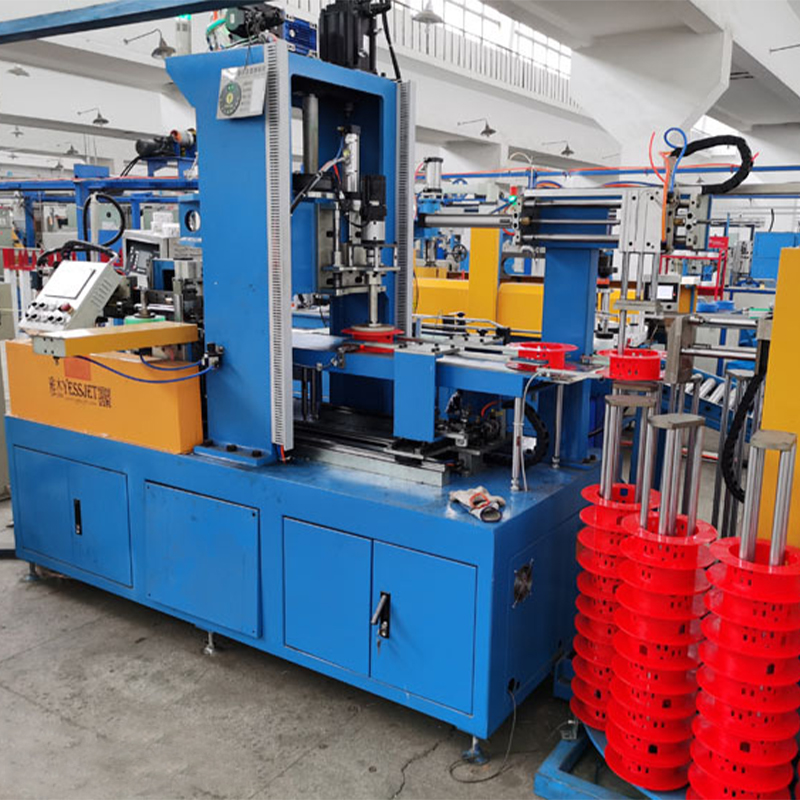
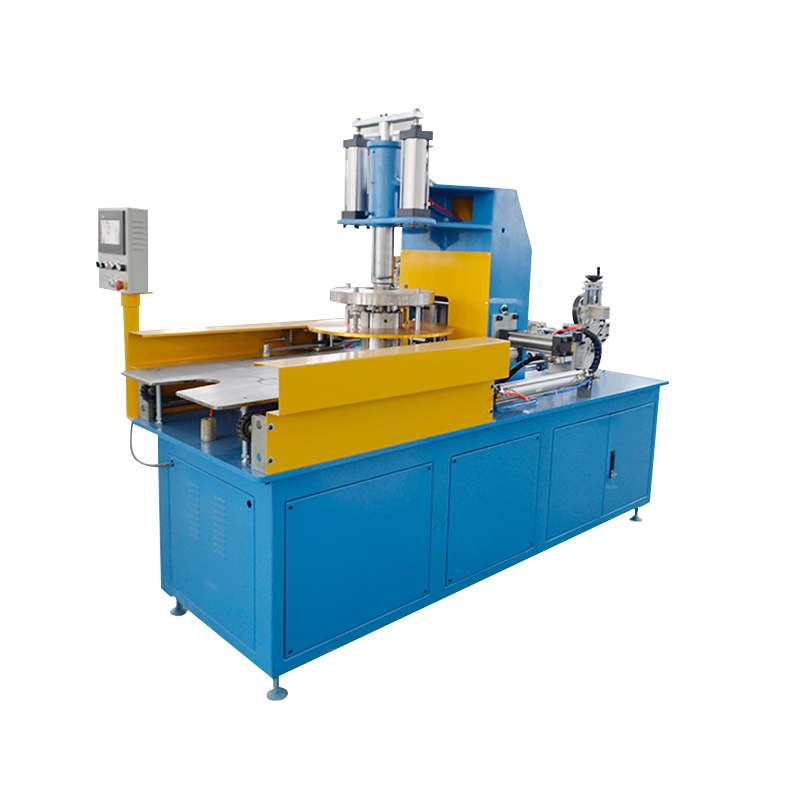
Yessjet's fully automatic coiling and packaging equipment is designed with this integration in mind. The coiling, wrapping, and binding machines in the product range produce finished coils at the dimensions and consistency required for reliable automatic label application downstream—coils of uniform diameter and flat face geometry are a prerequisite for consistent ±1mm label placement. When the label feeder is sourced alongside the coiling and packaging equipment from the same manufacturer, the interface specifications, conveyor heights, and coil delivery geometry are coordinated by design rather than requiring custom integration work on site.
For cable manufacturers planning or upgrading complete production lines—from extrusion through coiling, packaging, labeling, and palletizing—Yessjet's complete cable production turnkey solutions cover the full equipment sequence with coordinated design, installation support, and commissioning services to ensure every station in the line operates as an integrated system from day one.