LANGUAGE
 中文简体
中文简体 русский
 Français
 Español
 Português
 عربى
عربى
Content
- 1 The Shift from Traditional Palletizing to Autonomous Intelligence
- 2 Key Technological Enablers for Modern Stacking Cells
- 3 Cost-Benefit Analysis: Beyond Labor Savings
- 4 Integration Strategies to Minimize Downtime
- 5 Gripper Technology: The End-Effector Ecosystem
- 6 Data-Driven Stability and Predictive Maintenance
The core financial advantage of deploying an intelligent robot stacker today lies in a 40% reduction in logistics handling costs and a payback period that has shrunk to under 18 months for high-volume facilities. This is no longer a speculative technology; modern 3D vision-guided cobots are solving the labor shortage crisis while achieving palletizing error rates below 0.1%.
Achieving this level of efficiency doesn’t happen by simply swapping a manual operator for a robotic arm. It requires a strategic shift toward mixed-case palletizing, dynamic path planning, and edge-based quality inspection. Here is how modern systems are restructuring the end-of-line packaging floor.
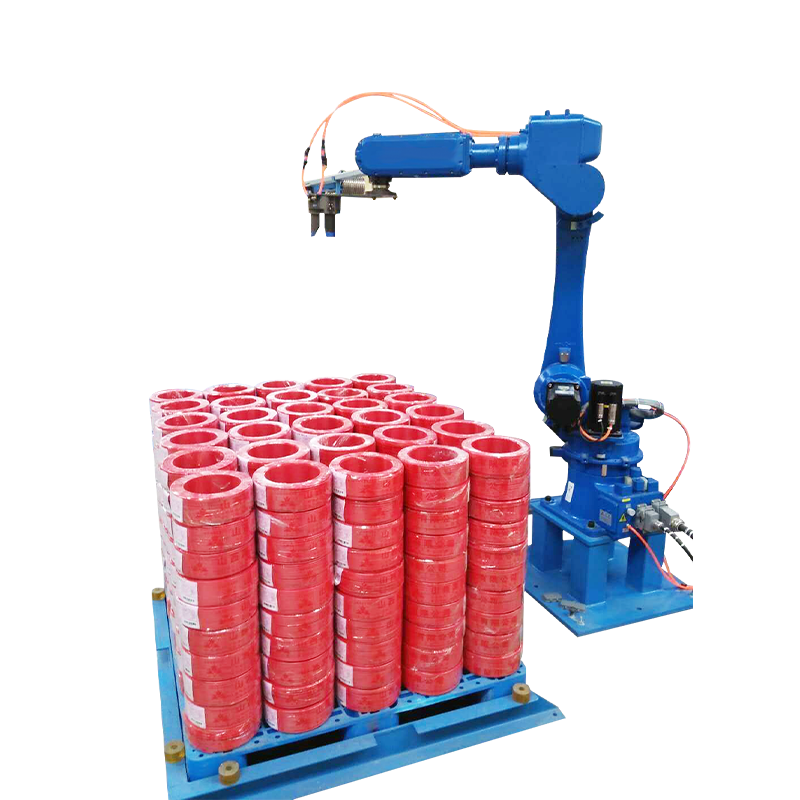
The Shift from Traditional Palletizing to Autonomous Intelligence
Traditional palletizers, whether layer-forming or high-level infeed, operate on rigid, pre-programmed patterns. They excel at moving a single SKU in a continuous loop but fail catastrophically when handling the variability of e-commerce orders. An intelligent robot stacker closes this capability gap by combining adaptive gripping with real-time decision-making.
The operational difference lies in the data flow. A traditional line uses a teach pendant and fixed mechanical stops. An intelligent cell uses an RGB-D camera array to capture a point cloud of the incoming case, analyzes its dimensions within 50 milliseconds, and commands the gripper to adjust suction cup activation or jaw width instantly. This enables true mixed-case palletizing without barcode pre-sorting.
Key Technological Enablers for Modern Stacking Cells
Understanding the hardware and software stack is essential for specifying a system that won't become obsolete. The field has consolidated around three critical components that directly impact throughput and stability.
AI Vision and Volumetric Measurement
Vision is the most significant cost driver and performance differentiator. Top-tier systems now achieve a pick accuracy of 99.8% on black-on-black shrink-wrapped packages, a historically difficult task for laser scanners. By using deep learning to classify deformable items like polybags, the robot dynamically assigns the optimal stack location to prevent leaning towers, reducing pallet collapses during transport by 65%.
Perimeter Safety and Human-Robot Collaboration
Speed is governed by safety. Power and force limiting (PFL) cobots eliminate the need for tall wire-mesh fencing, reducing the footprint by 30%. A recent update in ISO/TS 15066 allows for adaptive speed control; the robot stacker can move at 3 meters per second when the safety zone is clear but decelerates smoothly to 0.5 meters per second when a forklift driver enters the proximity zone, eliminating frequent E-stop interruptions.
Cost-Benefit Analysis: Beyond Labor Savings
While removing one operator per shift saves roughly $45,000 annually, the hidden value in an intelligent system often comes from product protection and downstream carrier compliance. The table below breaks down the realistic performance metrics observed in a mid-tier 3PL warehouse handling consumer packaged goods.
| Performance Metric | Manual Operation | Intelligent Robot Stacker |
|---|---|---|
| Sustained Rate (cases/hour) | 350 | 600 |
| Product Damage Rate | 1.5% | 0.2% |
| Pallet Space Utilization | 78% | 92% |
| Re-scan/Correction Rate | 2.0% | 0.1% |
The jump in space utilization from 78% to 92% directly translates to fewer trucks on the road. An intelligent stacker calculates interstitial placement, filling voids with smaller boxes rather than dunnage, saving an estimated $120 per trailer load in freight optimization.
Integration Strategies to Minimize Downtime
A common deployment failure is treating the robot stacker as an isolated island. Successful integrations rely on deep WMS handshakes. Instead of a basic start/stop signal, the system should receive real-time order line data. Here is a proven implementation sequence:
- Pre-deployment audit using a stationary camera to log case dimensions and variance for two production weeks.
- Digital twin emulation where the actual order backlog is run through the virtual controller to identify gripper clash points.
- Phased cutover running on a "ghost" line that mirrors the production conveyor but sends the signal to a virtual PLC, validating pallet quality without blocking throughput.
Gripper Technology: The End-Effector Ecosystem
A single robot arm is useless without the correct end-of-arm tooling. The trend is shifting toward hybrid adaptive grippers that merge the following functionalities within a single carbon-fiber chassis:
- Vacuum zone control: selectively activates hundreds of micro-foam channels to grip porous cardboard or perforated shrink wrap.
- Under-finger clamps: essential for handling open-top cases or trays holding loose beverage cans, preventing lateral ejection during high-speed turns.
- Dynamic slip detection: an inertial measurement unit detects micro-slips of 0.5mm, triggering an immediate on-the-fly re-grip without dropping the product, maintaining a cycle time of 6 cycles per minute.
Data-Driven Stability and Predictive Maintenance
The long-term value of an intelligent stacker lies in the vibration and torque data it generates. By monitoring the specific current draw on axis-3 motors during a high-stack maneuver, facilities can predict harmonic gear wear 200 hours before failure. This avoids the catastrophic downtime scenario where a seized axis idles an entire shipping dock. Continuous monitoring of stack compression force also ensures cold-chain items are not crushed as they expand in transit, a compliance necessity for pharmaceutical logistics under GDP guidelines.